

Table of Contents
What Happens When You Skip Yoga for a Week?
It starts with one rainy morning in Chennai when the bed feels a little too warm, or perhaps a hectic work week at the IT park that stretches late into the evening. You tell yourself, “It’s just one day.” But one day turns into three, and suddenly, seven days have passed without you unrolling your mat. If you are wondering what happens when you skip yoga for a week, you aren’t just losing out on a workout; you are pausing a vital conversation between your mind and body.
In a fast-paced city like Chennai, yoga acts as a pressure valve. When you skip it for a full week, the physiological and psychological “backlog” begins to accumulate. Your fascia starts to stiffen, your breath becomes shallower, and the mental clarity you worked so hard to build begins to fog over. However, this isn’t a reason for guilt. Understanding the “detraining” process is actually the first step toward building a more resilient, long-term habit. Whether you are a regular at outdoor yoga sessions or a dedicated home practitioner, knowing the effects of a seven-day break helps you navigate the return to your mat with compassion and strategy.

What is Yoga Detraining?
Yoga detraining refers to the gradual decline in physical flexibility, muscular endurance, and mental focus that occurs when a regular practice is interrupted. Within one week, the body begins to lose its “spatial memory,” connective tissues become less hydrated, and the nervous system shifts back from a relaxed state to a more reactive, stress-prone mode.
Why it Matters: The Cumulative Effect of Presence
Consistency is the secret ingredient that transforms yoga from a simple stretch into a life-altering practice. When we practice regularly, we are constantly “oiling” our joints and “resetting” our nervous system. Skipping a week matters because it highlights how much we rely on yoga to buffer us against the stresses of modern Indian life.
For someone living in a high-density urban environment, yoga is often the only time in the day when the “fight or flight” response is silenced. A week without that silence can lead to increased irritability, physical lethargy, and a resurgence of chronic aches, such as “tech-neck” or lower back stiffness. Understanding this impact allows you to see yoga not as a chore you “missed,” but as a vital nutrient your body is currently craving.
How it Works: The Timeline of a Seven-Day Break
What actually happens inside your cells when you step away from the mat for seven days? The process follows a specific physiological timeline:
- Days 1–2 (The Residual Glow): Your body still carries the benefits of your last session. You might feel a bit more energetic, as the muscles are in full recovery mode.
- Days 3–4 (The Fascial Stiffening): The connective tissue (fascia) begins to lose its fluidity. Without the regular lengthening of yoga, these tissues become “sticky,” and you may notice your morning stretches feel slightly tighter.
- Days 5–6 (The Mental Shift): The cortisol-lowering effects of Pranayama (breathwork) begin to wane. You might find yourself reacting more sharply to traffic on Mount Road or feeling more anxious about work deadlines.
- Day 7 (The Threshold): By the end of the week, muscle memory is still intact, but the “will” to practice feels heavier. The psychological barrier to restarting is now at its highest.
The Effects: Physical, Mental, and Emotional
Physical: The Loss of “Slide”
Yoga keeps the body’s internal structures sliding smoothly against each other. After a week, the lack of movement leads to a decrease in synovial fluid production in the joints. You aren’t “unfit” yet, but you are certainly less “fluid.”
Mental: Reduced Cognitive Buffer
Regular yoga increases “vagal tone,” which helps you stay calm under pressure. Skipping a week reduces this buffer. You may notice your focus drifting during meetings or a general sense of “brain fog” that yoga usually clears away.
Emotional: The Return of Restlessness
Many practitioners use yoga to process the “emotional debris” of the day. Without this outlet for a week, minor frustrations can feel like major crises. The sense of being “grounded” is replaced by a sense of being “adrift.”
How Beginners Can Approach the “Restart”
If you are a beginner and you’ve just skipped your first week, don’t let it become a month. Here is how to step back on the mat safely:
- Lower the Bar: Don’t try to do the most intense 90-minute flow. Start with 15 minutes of gentle sun salutations or floor stretches.
- Focus on Breath First: Your lungs “detrain” slower than your muscles. Spend 5 minutes on Anulom Vilom to reconnect with your focus before moving physically.
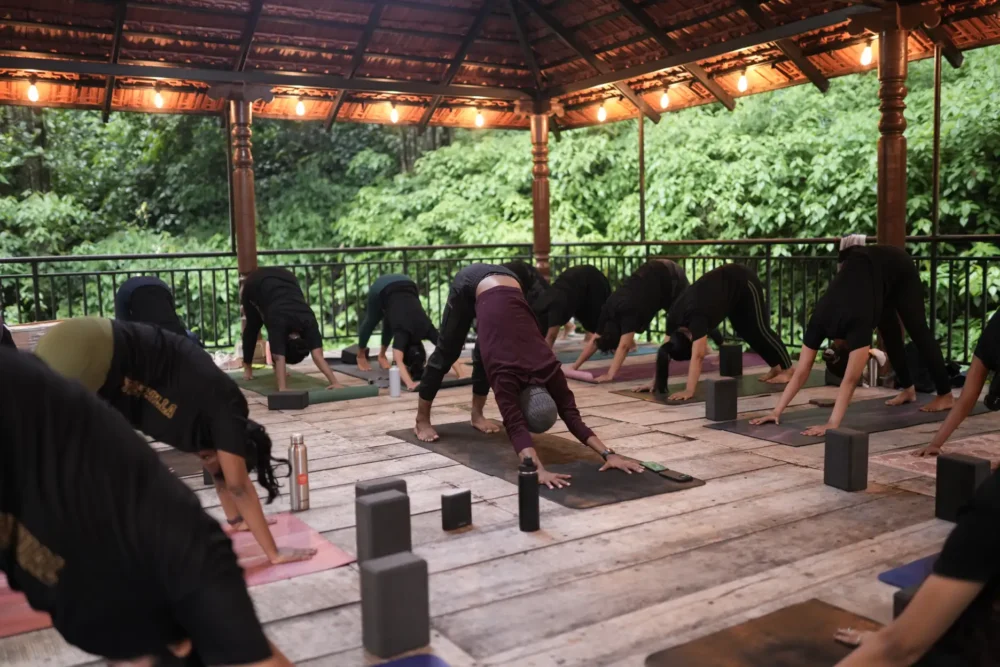
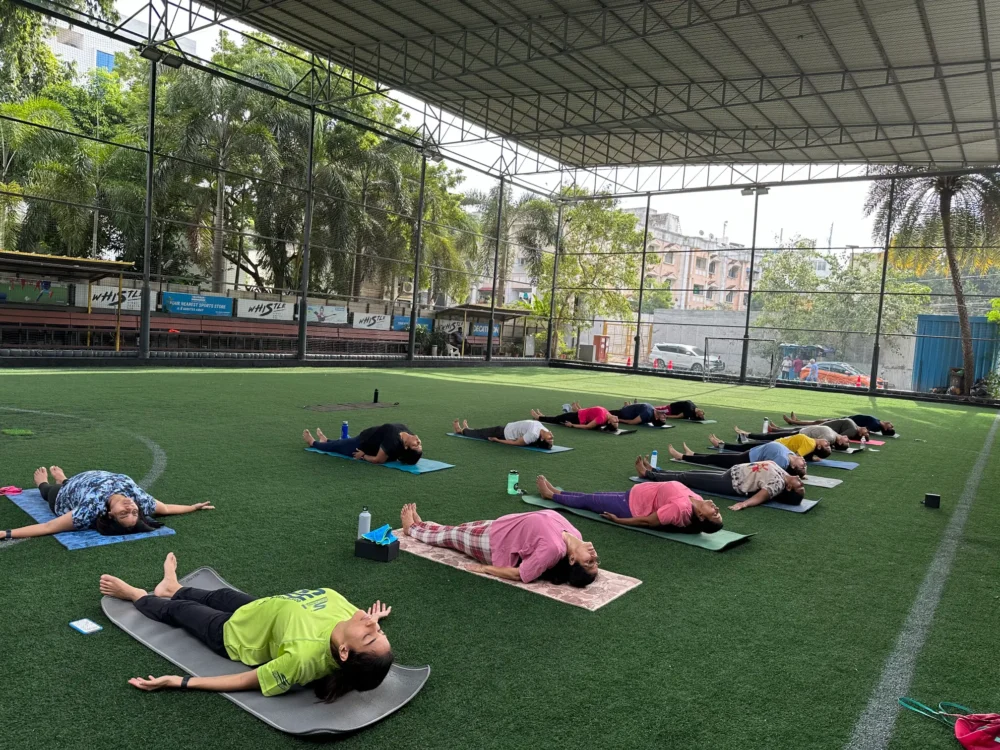
- Join a Guided Session: It is much easier to restart when someone else is leading. Book a live online yoga class or head to a local park in Chennai for an outdoor session to regain the group energy.
- Forgive the Stiffness: Your first session back will feel harder than usual. Acknowledge the stiffness without judging it.
Common Misunderstandings About Skipping Yoga
“I’ve lost all my progress.” False. Muscle memory is incredibly resilient. You might feel stiff for the first 10 minutes of your return, but your body will “remember” its alignment much faster than it took to learn it initially.
“I need to ‘punish’ myself with a double session.” This is a recipe for injury. Skipping a week makes your tissues more prone to strain. Returning with double intensity is counterproductive.
“If I can’t do my full routine, I shouldn’t bother.” This “all or nothing” thinking is the biggest enemy of consistency. A 5-minute stretch in your office chair is better than zero minutes on the mat.
Real-World Scenarios
Scenario A: The Chennai Corporate Lead
Aditi, a project manager in Perungudi, skipped her yoga for a week due to a product launch. By Friday, she noticed her old sciatica pain flaring up and her sleep quality plummeting. She realized that while she saved time by not practicing, she lost efficiency due to her physical discomfort. She restarted with a gentle 20-minute evening flow and felt her “body-clock” reset almost instantly.
Scenario B: The New Student in Besant Nagar
Rahul had just started his yoga journey when he caught a mild cold and skipped a week. He felt intimidated to go back to the beach sessions, fearing he would be the “stiffest” person there. After a quick chat with his instructor, he learned that breaks are part of the path. He returned, used a block for support, and found that his body was back to its previous level within two sessions.
Practical Tips for Staying Consistent
- The “Non-Negotiable” Five: Even on your busiest days, commit to 5 minutes of Sukshma Vyayama (joint loosening). It keeps the habit loop alive in the brain.
- Keep the Mat Visible: Don’t tuck your mat away in a cupboard. Keep it in a corner where you can see it; it acts as a visual “nudge.”
- Use Digital Reminders: Set a gentle alarm on your phone for “Mat Time” rather than “Workout.”
- Find a “Yoga Buddy”: Having a friend in Chennai to check in with makes you significantly more likely to show up on those low-motivation days.
FAQs
1. Is it bad to take a week off from yoga? No, sometimes the body needs rest for deep tissue repair. The danger isn’t the rest; it’s the difficulty of restarting.
2. Will I lose my flexibility in just seven days? You won’t lose the structural length of your muscles, but you will lose “functional” flexibility as your fascia loses hydration and becomes stiff.
3. How do I get back into yoga after a long break? Start with “Restorative” or “Hatha” styles. Avoid “Power” or “Vinyasa” for the first two days to allow your joints to re-lubricate safely.
4. Can skipping yoga cause back pain? If you use yoga to manage existing postural issues (like sitting at a desk), a week off can definitely lead to a resurgence of stiffness and pain.
5. Does my “yoga streak” matter? While streaks are motivating, don’t let a “broken streak” stop you. The goal is a lifelong relationship with yoga, not a perfect calendar.
6. Can I still do breathwork if I skip the poses? Absolutely. If you are too busy for asanas, practicing 5 minutes of Pranayama keeps the mental benefits of yoga active even during a physical break.
7. Should I eat more or less during a break? Focus on anti-inflammatory foods. Since you aren’t moving as much, keeping your digestion light will make it easier to return to the mat.
8. Are online classes better for busy weeks? Yes! Live online yoga classes in India are perfect for busy weeks because they eliminate travel time, making it harder to find an excuse to skip.
Conclusion: The Mat is Always Waiting
Yoga is a journey of a thousand miles, and every journey has its rest stops. Skipping a week isn’t a failure; it is simply a pause in the music. Your muscles may feel a bit tighter and your mind a bit noisier, but the foundation you’ve built hasn’t disappeared.
In the humid, vibrant air of Chennai, life will always find ways to distract us. The beauty of yoga is that it doesn’t demand perfection—it only asks for your return. Whether it’s been seven days or seven months, the mat is always waiting, ready to help you breathe, move, and find your center once again.




Leave a Comment