

Table of Contents
What Mistakes Do Beginners Make in Yoga
Stepping onto a yoga mat for the first time is a brave act of self-care, but it often comes with a hidden backpack of expectations and misconceptions. In the vibrant wellness hubs of Chennai, from the quiet studios in Adyar to the breezy outdoor yoga sessions at Besant Nagar, many newcomers start their journey with great enthusiasm only to find themselves frustrated or, worse, injured.
The primary reason for this isn’t a lack of ability; it is usually a handful of common “newbie” errors that are easily corrected. Most beginners treat yoga like a competitive sport or a standard gym workout, forgetting that yoga is a physiological and neurological recalibration. When you ask, “What mistakes do beginners make in yoga?”, you are really asking how to bypass the frustration and get straight to the healing. This guide explores the most frequent pitfalls—ranging from holding your breath to the “comparison trap”—and offers practical, empathetic solutions to help you build a sustainable, lifelong practice.

What are Beginner Yoga Mistakes?
Beginner yoga mistakes are common errors in physical alignment, breathing technique, or mental approach that newcomers unknowingly commit. These include pushing past physical pain, ignoring the breath-to-movement connection, and prioritizing the “aesthetic” look of a pose over its functional purpose and safety.
Why it Matters: The Risk of the “Push”
In a high-pressure city like Chennai, we are conditioned to believe that “more is better.” We push through traffic, push through work deadlines, and then we come to the mat and try to push into a split on day one. This “push” mindset is the antithesis of yoga and can lead to repetitive strain injuries in the wrists, lower back, and hamstrings.
Understanding these mistakes matters because it preserves your enthusiasm. When you practice correctly, you feel energized and “spacious.” When you make these common errors, you feel depleted and sore. By identifying these pitfalls early, you protect your joints, regulate your nervous system more effectively, and ensure that your yoga journey is measured in years, not just weeks of burnout.
How it Works: The Anatomy of a Safe Practice
Yoga isn’t just about the shape of your body; it’s about the state of your internal systems. Here is how a corrected, error-free approach works:
- Foundation First: You learn to ground through the “four corners” of your feet and the “L-shape” of your hands to protect your joints.
- Breath Synchronization: You stop holding your breath and start using it as a metronome for your movement.
- Active Engagement: Instead of “collapsing” into a stretch, you learn to engage opposing muscles to create stability.
- Prop Integration: You stop seeing blocks and straps as “crutches” and start seeing them as “spatial enhancers” that make poses accessible.
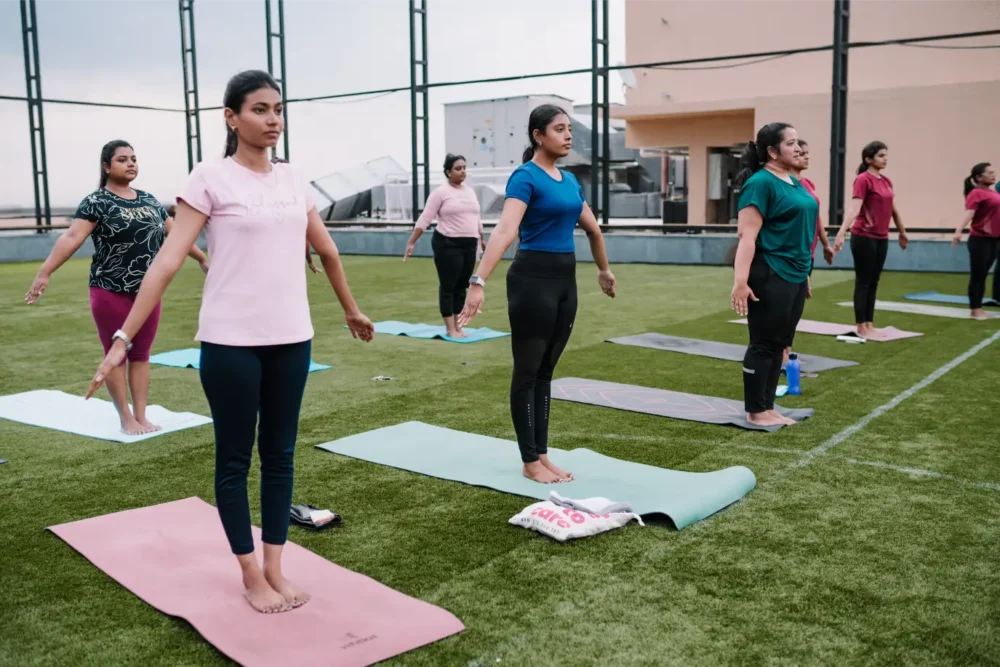
The 10 Most Common Mistakes Beginners Make
1. Holding the Breath
Perhaps the most universal error. When we concentrate hard, we tend to hold our breath. In yoga, this creates tension in the brain and deprives the muscles of the oxygen they need to stretch safely.
2. The Comparison Trap
Looking at the person on the next mat (or on Instagram) and trying to mimic their depth. Every body has a different skeletal structure; what looks “perfect” for one person might be damaging for another.
3. Pushing Past Sharp Pain
Beginners often confuse “sweet discomfort” (muscle lengthening) with “sharp pain” (nerve or ligament strain). If it feels like a pinch or an electric shock, you must back off immediately.
4. Ignoring the Core
In poses like Plank or Downward Dog, beginners often let their bellies sag. This puts immense pressure on the lower back and shoulders.
5. Wearing the Wrong Gear
Loose, baggy t-shirts might seem comfortable until you are in a Downward Dog and the fabric is over your face. Conversely, overly restrictive clothing can prevent you from breathing deeply.
6. Skipping the “Warm-Up” (Sukshma Vyayama)
Jumping straight into Sun Salutations without waking up the wrists, neck, and ankles is a recipe for minor strains, especially in the early morning.
7. Competitive “Ego” Yoga
Trying to reach the floor in a forward fold by rounding the back excessively. It is better to have bent knees and a flat back than straight legs and a curved spine.
8. Not Communicating Injuries
Walking into a class (or a live online yoga session) and not telling the teacher about a bad knee or a recent surgery. Instructors can’t help you if they don’t know your history.
9. Rushing Out Before Savasana
The final relaxation is the most important part of the class. It’s when your nervous system “saves” the data of your practice. Skipping it leaves you in a state of high-alert.
10. Practicing on a Full Stomach
Trying to twist and bend with a heavy meal in your belly leads to indigestion and lethargy.
Real-World Examples: Learning from Experience
Scenario A: The Over-Ambitious Athlete in OMR
Kunal, a marathon runner, joined a yoga class in Chennai to improve his flexibility. He treated yoga like a race, trying to “win” every pose. By the third week, his hamstrings were more strained than ever. Once his teacher explained the mistake of “passive overstretching,” Kunal learned to micro-bend his knees. His pain vanished, and his running times actually improved because he was finally recovering properly.
Scenario B: The Quiet Student in Anna Nagar
Sunita felt self-conscious using blocks, thinking they were for “weak” people. She struggled with balance in Half Moon pose for months. After her teacher gently insisted she use a block, Sunita’s alignment snapped into place. She realized the mistake wasn’t her lack of balance, but her refusal to use the tools designed to help her.
How Beginners Can Approach a Mistake-Free Practice
If you are just starting out, follow these three simple rules to stay safe:
- Ask “Why?”: Don’t just follow the shape. Ask your teacher what the pose is supposed to accomplish. If it’s for back strength, and you feel it in your neck, you’re likely making an alignment error.
- Master the “Micro-bend”: Never lock your joints (knees or elbows). Keeping a tiny, almost invisible bend keeps the work in the muscles and out of the ligaments.
- Prioritize the Exhale: Whenever a pose gets difficult, focus on the exhale. It naturally triggers the relaxation response in the body.
Practical Tips for Your Daily Routine
- Arrive 10 Minutes Early: This gives you time to settle your mind and tell the teacher about any physical concerns.
- Invest in a “Sticky” Mat: A cheap, slippery mat makes you tense your muscles just to stay in place, which leads to fatigue and mistakes.
- Watch the Feet: Alignment almost always starts from the ground up. If your feet are misaligned, your hips and spine will be too.
- Use Your Mirror Sparingly: Focus on how the pose feels rather than how it looks.

FAQs
1. Is it normal to feel sore after your first yoga class? Yes, “Delayed Onset Muscle Soreness” (DOMS) is normal. However, you should not feel sharp pain in your joints or spine.
2. I can’t touch my toes; am I doing it wrong? Not at all! The mistake is thinking you need to touch your toes. The benefit comes from the stretch in your hamstrings, regardless of where your hands land.
3. Why do I get dizzy during transitions? This usually happens if you are holding your breath or moving too fast. Try to move slower and keep your gaze (Drishti) fixed on a single point.
4. Can I make mistakes in online yoga classes? Yes, but in live online yoga classes, the teacher can see your camera and provide verbal corrections to help you stay safe.
5. How do I know if I’m pushing too hard? If you can’t maintain a steady, smooth breath, you have gone too far. Your breath is your “stress-meter.”
6. Should I eat before yoga? Ideally, no. The mistake of eating a heavy meal before class can lead to nausea during inversions and twists.
7. Is it okay to use a towel if I sweat a lot? Yes! Especially in Chennai’s humidity, using a yoga towel prevents the mistake of slipping and injuring yourself on a wet mat.
8. What if I can’t do a pose at all? The mistake is forcing it. Every pose has a “modification.” Ask your teacher for a version that works for your current level.
Conclusion: Progress Over Perfection
Yoga is a practice of “Ahimsa,” or non-violence. This starts with how you treat yourself on the mat. Making mistakes is a natural part of the learning curve, but the biggest mistake of all is letting the fear of being “wrong” stop you from starting.
As you navigate the bustling life of Chennai, let your yoga mat be the one place where you don’t have to be perfect. Correct your breath, soften your gaze, and listen to your body. When you trade “pushing” for “listening,” you’ll find that the benefits of yoga arrive much faster than you ever expected.


Leave a Comment